
I cannot count the jugs I nearly sent across the kitchen floor over the years, trying to move hot soup from the pot into the countertop blender. Mine holds five cups, so a full pot of soup called for two or three careful pourings. The steam builds under the lid. If I did not vent it just right, the lid popped and hot liquid splashed the counter. On the worst night, I held a tea towel over the lid with one hand and guessed at the speed with the other, and I still ended up wiping tomato flecks off the backsplash. I finally bought a KitchenAid hand blender, and soup night changed completely. No pouring. No second hot container. No lid waiting to pop.
This is the method I use most weeks in the fall, when the squash and potatoes and the last of the garden tomatoes are calling. It gives me silky soup right in the pot, with no extra dish to wash and no risk of scolding my arm. And because nothing has to move, cleanup is just the wand, the whisk, and the lid of the chopper, all of which rinse under the tap in under a minute. Let me walk you through it exactly the way I would if you were standing at my stove with a cup of coffee and a dog leaning on your leg.
The hand blender I reach for on soup night
The KitchenAid variable-speed hand blender blends straight in the pot and the wand, whisk, and mini chopper all rinse clean in seconds. It has been the lowest-fuss tool in my kitchen all fall, and it stays in the drawer instead of collecting dust on a shelf.
Amazon Check Today's Price on Amazon →Step 1: Give the soup a few minutes to settle
The biggest mistake people make is blending soup the minute it comes off a hard boil. Steam is still pushing up through bubbles, and a spinning blade near that surface turns a simple task into a hot-spray event that stains whatever you are wearing. So before I ever touch the blender cord, I pull the pot off the heat and let it sit for five to ten minutes. I use the time to set out the bowls, slice the bread, and let whatever needed to soften, the last stubborn potato bit or a woody carrot, cook down on its own.
You do not want the soup cold, just no longer violently bubbling. Warm is perfect, warm enough to melt a knob of butter into a cream finish, cool enough to behave. This pause alone stops most of the splashing people blame on the blender itself. If I am in a real hurry and company is minutes away, I stir the pot once and wait just until the big bubbles stop rolling. That is usually enough to make it safe.
One more thing while you wait. Look at the blade area of your wand and make sure nothing is tangled around it. A stray piece of twine from a tied herb bundle, or a long bit of celery fiber, will wrap the blade and dull the whir. A quick look now saves you a trip to the sink with a stuck blade later.
Step 2: Seat the wand and get the bell fully under
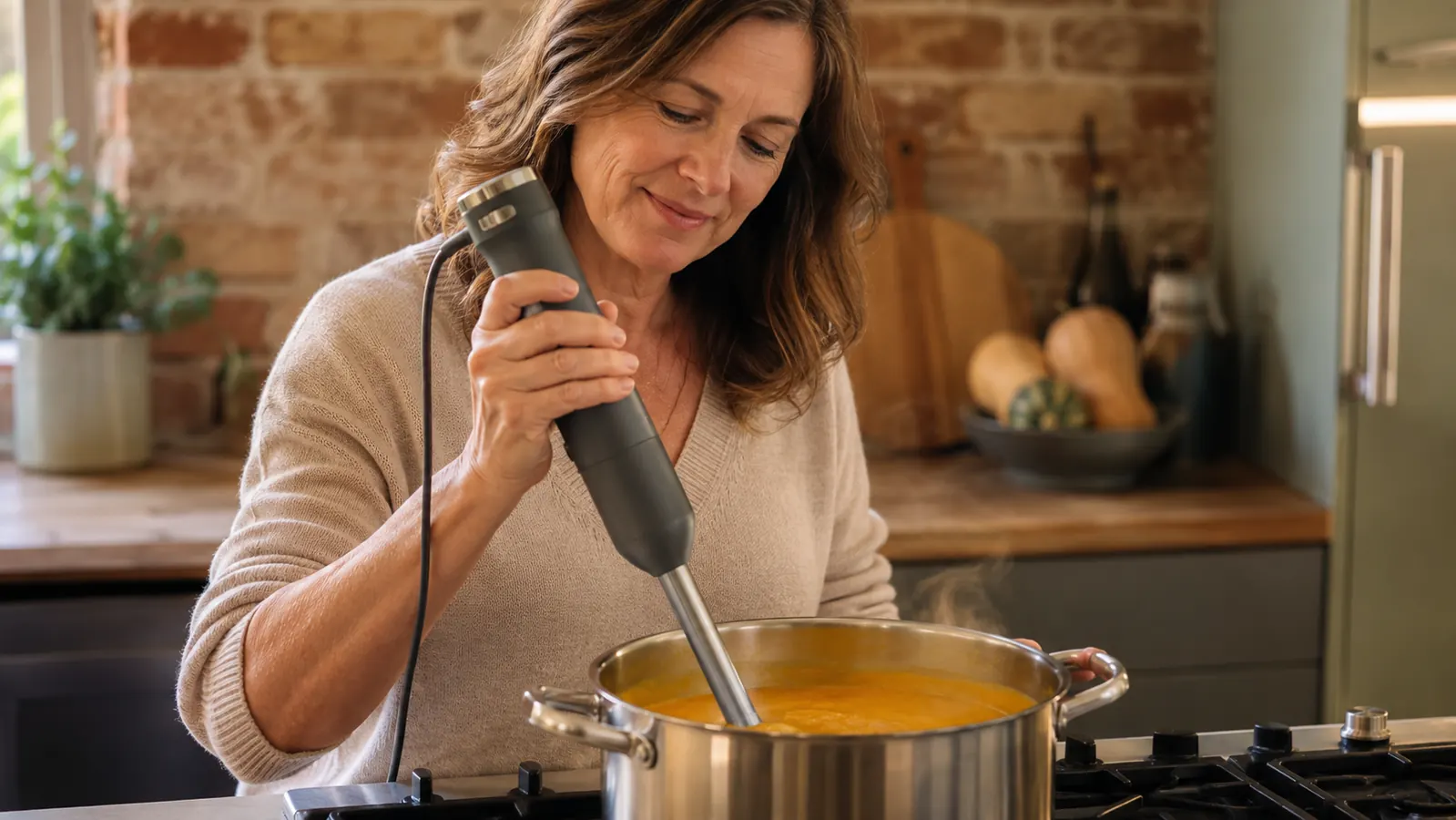
Hold the KitchenAid hand blender so the bell, the little metal guard that surrounds the blade, is fully submerged before you ever press the speed button. This is the single most important thing I can tell you, and I will sound like a broken record about it because it is that important. If even the top edge of the bell pokes above the surface, the blade sucks air the same way it sucks soup, and it throws both back at you in a fine, hot mist all over your pullover and your sleeves.
I tilt the wand just slightly, maybe ten or fifteen degrees off vertical, and keep the bell a good inch or two below the surface. The tilt matters more than you think. Air trapped under the bell escapes through that small tilt instead of making the blade rattle and foam at the top of the soup. Keep the tip below the surface the entire time the motor is running. You can lift it out to reposition between batches, but never run the motor with the tip out of liquid. That one habit, keep it under, prevents ninety percent of the mess and nearly all of the splatter burns.
If you are blending in a heavy pot, hold the pot handle with your free hand. The blade creates a gentle torque that can walk a light pot across the stove top if you are not holding it steady. A heavy enameled pot stays put on its own, but the habit of keeping one hand on the handle keeps both pot and blending arm calm, and it stops your arm from tiring as fast.
Step 3: Start slow, then build the speed
Here is where the variable speed on this KitchenAid earns its place in my drawer. I start at the low end, maybe a quarter of the way around the dial, and let the blade get established before I ask it to do any real work. Starting fast throws soup up the side of the pot, foams the surface, and leaves the bottom entirely untouched. Starting slow pulls the liquid down into the blade and starts a gentle swirl you can feel through the handle.
Once I feel that little whirlpool forming, I bring the speed up to about half and hold it there. Most soup only needs medium. Something fibrous, like a leek and potato soup with tough leek greens, might want a short push toward the top of the dial, but only in quick pulses. The rest of the time, medium and steady does more good. Soup is not a smoothie. It needs persistence, patience, and a little time, not raw power you were not planning to clean off the stovetop.
Listen to the motor, too. It tells you what is happening. If it whines high and thin, the blade is mostly spinning in air or foam, and you need to tilt deeper or submerge the bell further. If it thumps, you have hit something solid, a whole potato or a hunk of squash, and you should give it a press or two rather than pushing on through. A smooth, mid-range hum means you have found the sweet spot. It is a small thing, but learning the sound of your own blender saves a lot of guessing.

Step 4: Work the pot in a slow, patient pattern
I do not stand in one spot hoping the blade reaches every corner. I move the wand in slow, lazy circles around the pot, tipping it gently to swing the bell out toward the sides where the potatoes and carrots hide. Then I lift just a little and lower again, in easy strokes. Picture a cave diver sweeping a light across a room. The blade needs to visit every corner to catch every chunk, and only an unhurried circuit gets that done.
Do not let the bell come fully to the surface between strokes. Keep it sliding just under the liquid the whole way around the pot. If your pot is full, and mine frequently is, blend in rough working sections. Spend a slow pass in one quarter of the pot, move to the next, then take one full lap around the edge to weld the borders between sections together. Ninety seconds of this usually leaves a perfectly even surface, no lumps and no streaks.
Tilting the wand outward as you circle pulls the blade against the sloping side of the pot, which is exactly where unblended vegetables settle. Straight up and down, held in the center, keeps the blade in the easy middle and ignores the edges. So let the carousel motion be your main move, and use the up-and-down strokes only now and again to lift the bottom layer into the swirl. Between the two, nothing gets left behind.
Step 5: Check, stir, and finish with a bright touch
Lift the wand clear, let it drip back into the pot, and look at the surface. You are after a single, even sheen with no floating flecks. If you still see lumps, sweep the pot once to bring them to the middle, then give it another short pass, pulsing rather than running steady. The pulse gives the blade a fresh bite at whatever is left instead of just spinning the soup in place and polishing what is already smooth.
When it is smooth, stir in your finishing fat and season to taste. A swirl of cream, a knob of butter, or a good drizzle of olive oil turns a good soup into a silky one. This is also the moment to adjust the salt, because blending can change how seasonings sit on the tongue. Taste at the very end, not before. Let the bowl sit for two minutes so the flavors settle together, then enjoy it while it is still properly warm. That last taste, at the table with bread and company, is the whole point of the extra two minutes.
The whole soup blends in about ninety seconds once it has cooled enough to settle, and there is not a single jug to pour or scrape. That is the quiet reason this tool stays in my drawer and the big blender does not.
What Else Helps
The attachment set that came with my KitchenAid hand blender is more than a gimmick I packed away and forgot. The mini chopper makes quick work of an onion for the bottom of the pot before you ever start the soup, and the wire whisk is the best thing I have found for smoothing cream into a hot finish without it splitting. Both rinse under the tap and dry on the rack in minutes, and they have kept me from dragging out the food processor for what turns out to be a ten-second job.
If you want an even silkier result, you generally do not need a fine-mesh strainer, except for those rare pots where you cooked something with tough skins that would not break down no matter what. On an occasional tomato soup with stubborn skins, a quick strain after blending catches what the blade cannot. But for the ordinary squash, potato, tomato, and bean soups that fill my kitchen all week, the hand blender alone is plenty, and it leaves me one fewer pot to wash.
One honest downside, and I will give it to you plainly because I have no interest in a sales pitch. An immersion blender will never make a smoothie as smooth as a big countertop machine, and it will not crush ice worth a darn. I keep my countertop blender for those two jobs, and I pull it out when I need it. But for soup, which is where I do most of my blending in the cooler months, the hand blender wins by a wide margin, because it does the work in the pot where the food already lives. No second container, no jug to guard against steam, no lid to hold down with a towel and hope.
If you are new to this, start with an easy pot of roasted squash or a batch of creamy tomato. Both turn silky with almost no effort and build your confidence for the trickier leek and potato pots. Before long you will stop fighting the texture and start noticing how much calmer soup night feels. That calm, not the gadget, is what you are really bringing home.
The full kit, ready on soup day
The wand, mini chopper, and whisk make the KitchenAid hand blender a small workhorse that earns its drawer all year. If soup nights live in your kitchen the way they live in mine, this is the one to have within reach.
Amazon Check Today's Price on Amazon →