
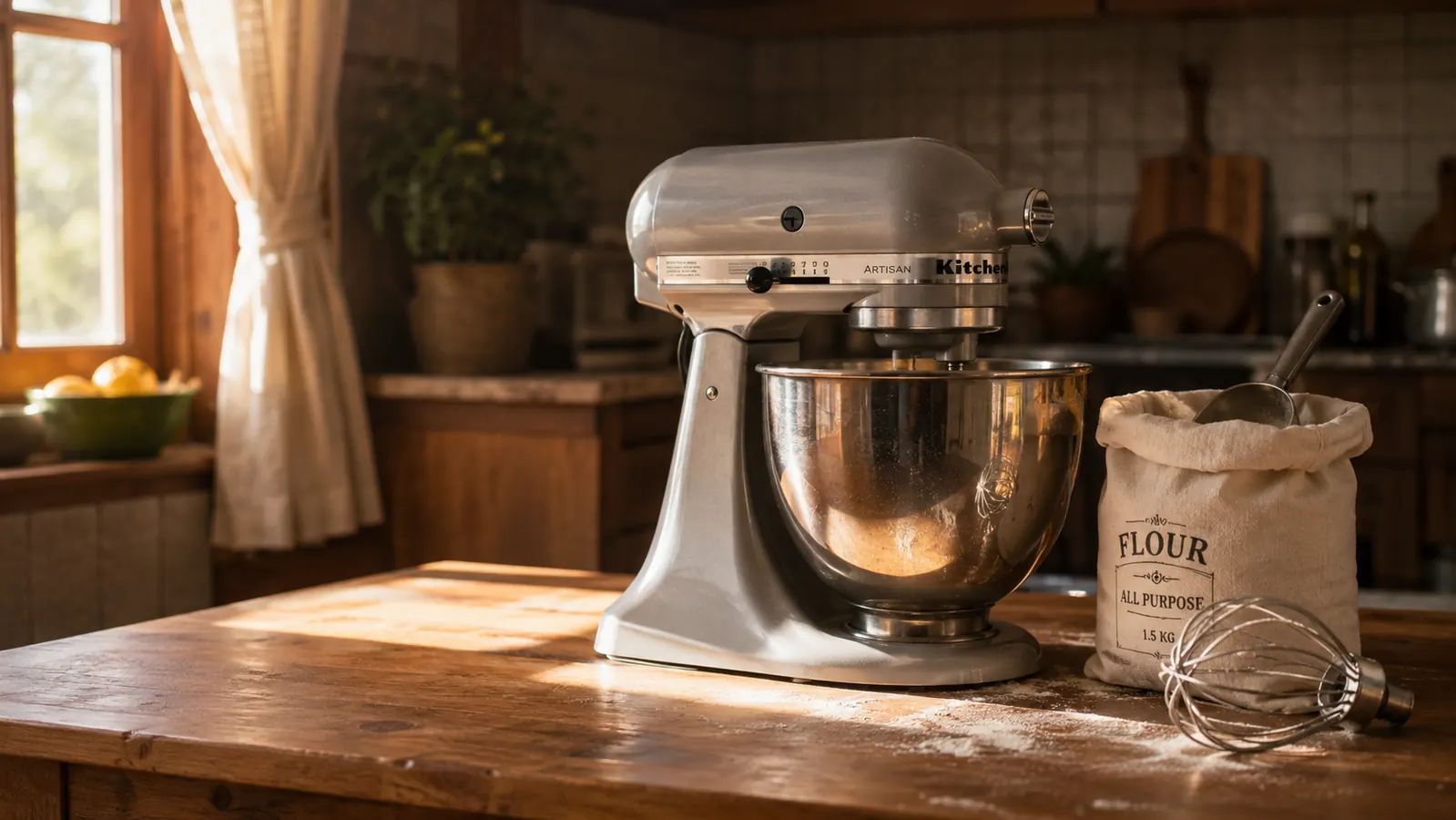
I resisted a stand mixer for a long time, and it was not only the counter space. I told myself that a machine would take the joy out of mixing, which is exactly the kind of thing a person says when she does not want to spend the money. Then one Saturday I worked a big batch of my grandmother's oatmeal cookie dough by hand, and by that evening I could not hold a book steady, let alone a spatula. The ache moved up into my wrist and it stayed for a few days. That was the turning point. I read, I compared the tilt-head against the bowl-lift, and I bought the KitchenAid Artisan 5-quart tilt-head mixer. That was a year ago, and this is the long view, not the first-week thrill that every new review sounds like.
The short version first. It is the one appliance in my kitchen that has never been pushed to the back of the counter, and that is a bigger deal than it sounds, because it means it actually earned its place. But I am not going to paint it as flawless. It is heavy, it is not the quietest companion on a stiff load, and the tilt-head wants more care than a shiny listing lets on. Those are all real, and I will be honest about them so you are not surprised after your own year rather than mine.
The Quick Verdict
After a full year of near-weekly baking, the KitchenAid Artisan is the appliance I reach for most. It is not silent through heavy dough, and the tilt head likes a drop of grease now and then, but for a home cook who bakes for people she loves, nothing else in my kitchen has earned its place the way this has.
Amazon Check Today's Price →The mixer that honestly earned a year of counter
I have owned this for twelve months and it still kneads and bowls like the day it arrived. If you have moved past hand mixing and you want the one mixer to keep for the long haul, today's price on Amazon is the honest place to start, no fine print.
Amazon Check Today's Price on Amazon →How I've Used It
Every week it gets used three days, sometimes four. A common week is a loaf of bread on Wednesday so the house smells the way I want it to, a batch of dinner rolls on Saturday morning, and a whipped cream or a small meringue on the day the grandchildren come over. With a home of two and grandkids stopping in most weekends, that is probably more use than most owners give it, and it is enough to show you a machine's true nature. Nothing gathers dust with this one, because the moment I set it down I reach for it again. The same KitchenAid iced a birthday cake in April and then handled the heavier dough for my weekly bread, so it sees both the delicate and the heavy work without complaint. It also turned out the stiff little portion of pizza dough my husband likes one Sunday without my arm aching, and whipped up a lopsided but well-liked chocolate frosting the same afternoon. A machine that handles both the feathery and the heavy in one weekend, without a single fuss, is hard to properly value until you have spent the years hand-mixing both.
The 5-quart bowl is the reason I chose this size over the bigger machines. It holds a single loaf easily and a full batch from my own cookbooks, and a double batch of cookies needs two rounds, each about five minutes of mixing. I would rather rinse a bowl twice than heave a heavier one, and that is the real tradeoff between the Artisan and the bigger bowl-lift units. For the meals we actually make in this house, this size is enough.
I keep it on the counter under a soft cover rather than lifting it in and out of a cabinet, because this machine is solid enough that it wants one honest place, and my back agrees. My dogs thread underfoot while I cook, so I keep it set back against the wall where a passing tail cannot knock it. That is a real part of the daily rhythm with a machine this heavy, you pick its place once and keep it there.
A word on how I chose the brand itself, since that is the question everyone really asks. I did not land on KitchenAid out of habit or because a parent swore by one. I looked at how long the machines people owned first actually lasted, and the pattern was the same in most kitchens I walked into, the KitchenAid was the one still going. That longevity is the reason I was willing to give this appliance a permanent home on my counter in the first place. A year in, that bet has held up.

Why the Tilt-Head Beat the Bowl-Lift
The tilt head tips the whole front up. I can reach straight into the bowl, add a scoop of flour without stopping the machine, and scrape the beater as it turns. With a bowl-lift mixer you lower the bowl off a lever and hoist it back up, which is better if you are moving six quarts of heavy dough but less handy when you only want to peek in and keep going. For the way I actually bake, the tilt head is the reason I still enjoy the machine after a full year instead of tolerating it. That easy reach is a small comfort no listing ever shows, but it is a real reason I pull this mixer out every week instead of reaching past it.
Here is the honest piece I would tell anyone comparing the two. The bowl-lift machines are the stronger dogs. They knead heavier and bigger batches and give a more workhorse feel, and if I were baking for a crowd or shaping a serious sourdough every weekend I might have chosen one. But they are much larger, they cost more, and you cannot look into the bowl the same way while you pour. For a home of two with grandkids on most weekends, the KitchenAid Artisan was the honest match, and I have never once wished I owned the other.
A note on the motor, since everyone comparing asks me the same thing. On the loads most of us actually bake, it is plainly enough. The weekday loaf that kneels in six minutes does not strain it at all, and it is only when I push a tripled, wet, heavy dough that the machine grumbles. That is the moment I would not reasonably ask of a home appliance anyway, so I accept it. If you feel that grumble once a month, that is the honest trade for a machine that fits the real scale of a home kitchen.
Where It Tests My Patience
Now the honest downsides, because a review that skips them does you no good. The machine is not quiet. On a stiff heavy dough it gets loud and it shakes, and if I do not steady the head it creeps an inch across the counter, which frightened me the first time. Once I learned to hold it with one hand while it kneads, it stopped being a worry, but I will not pretend a heavy load is ever silent. Over a year I have accepted that a machine which rattles a little is also the one that just keeps working, and I made my peace with that trade. On a busy morning, with a dog barking at the mail carrier and the mixer rising to meet a heavy batch at the same time, I simply wait it out. It has never walked far enough to worry me, and it has never thrown a bowl off its mount, which is more than I can say for the two battery hand mixers this same week of baking would have run through.
The bowl is not dishwasher safe, so I wash it and the beater by hand every single time. That is a real cost and it stays with the machine, so I say it plainly. Bigger batches also send a light drift of flour over the top rim when I add dry flour too fast. The tilt hinge wants one drop of food-safe grease on its own pivot every couple of months or the head starts to lean. None of this has ever broken anything, but you will not find it on the first page of the manual.
The other honest limit is where the larger bowl-lift models truly earn their place. A wet, dense whole-grain loaf turns the Artisan louder and more strained at its top speed, and there the bigger machine would drive through with room to spare. When a loaf really fights, I let this one tell me it has had enough instead of pushing it past the place it is built for. I have never once strained it to a ruined bake, because I bought the size to match the scale I cook. I have learned where its limit sits and I stay on this side of it, which is the honest way to keep a good machine running for a long life.

A Year of Daily Use
The first truth a year taught me is the hook. A two-loaf batch of a simple crusty dough becomes one smooth, springy ball in about six minutes at speed two, and it has never once ruined a dough I gave it. That alone is why I am sure a stand mixer beats hand mixing for anyone who bakes most weeks. No spoon can make a batch this smooth in six minutes while my arm stays free. It is the difference between baking from want and baking from habit, and after a year the habit has won. I have learned its rhythm, start slow at speed two so the flour stays seated in the bowl, then let it climb once the dough stops clinging to the sides. Done that way the gluten builds on its own and the loaf bakes up with a crumb I used to get only from the bakery two towns over.
For the rest of the weekly work, it whips egg whites for small meringues and cream to stiff peaks in under five minutes, and it creams butter and sugar into a smooth batter with no lumps left in the bowl, which was the first thing I checked. The flat beater reaches the whole surface as it turns. The longer, slower story of the same year is in my other honest review of the mixer.
The surprise I did not expect is that it made me bake more, not less. When this machine does the work and the cleaning is one bowl and one tool, a weekday loaf stops being a chore and becomes the reward. For a kitchen meant to earn its keep, that shift alone was worth the whole machine.
The attachment hub on the front uses the same standard drive as the bigger KitchenAid models, which surprised me because I assumed the Artisan would be its own island. I own two attachments and both earn their place in the drawer. Because the drive is standard, anything I add later is not wasted while I keep this machine. That open door matters as much to me as the bowl that came in the box. The extra tools store flat in the cupboard, out where the dogs cannot reach them.
One more small thing I have come to appreciate. The machine forges a clean center into every mix because the beater clears the whole bowl on the way around, so there is no scraping halfway through the way there was with every battery hand mixer I owned. It is a small daily comfort, but a year of it is a quiet weight off a cook's routine.
The dough hook has kneaded a two-loaf batch in about six minutes for a full year now, and it has never once overworked a loaf I gave it.
What I Liked
- Kneads a two-loaf batch in about six minutes without overworking the loaves
- The 5-quart bowl is the right size for a home that bakes weekly
- Whips egg whites and cream to a firm peak in under five minutes
- A standard front hub lets the machine grow with you
- Holds its value and build quality for the long years
Where It Falls Short
- It is loud and shakes on a heavy load unless you steady the head
- The bowl and the beater are hand-wash, every single time
- A little flour sprays over the top if you add it too fast
- The tilt hinge wants a drop of grease every few months
- A double batch of cookies takes two full bowl runs
Who This Is For
This is for the home cook who honestly bakes most weeks. That is the test that matters, and the one I give any person who asks. If you will really keep it busy three days a week the way I do, this is the one to own, and it will sit on your counter the way it does on mine. It is also a middle size, neither so small that a batch outgrows it nor so big that it owns the whole counter, which is where most of us live. That middle ground is where most of us cook, and it is why the machine earns its keep instead of just claiming its spot on the counter.
Who Should Skip It
Skip it if you honestly bake a few times a year, or only bring out a mixer for the holidays and a visiting grandchild. A full stand mixer sitting almost unused on the counter earns no keep. A good hand mixer will serve that life just fine and hand your counter back. And if you will not wash a bowl by hand, weigh that choice, because the bowl and its beater are a hand wash every single time.
A year in, this is the one I still reach for
After twelve months the Artisan is still the first thing I take off the shelf, and it shows no real wear. If you are ready to stop mixing by hand and you want a mixer that truly serves you and lasts, today's price on Amazon is the honest place to begin. It is the one I plan to keep.
Amazon Check Today's Price on Amazon →